
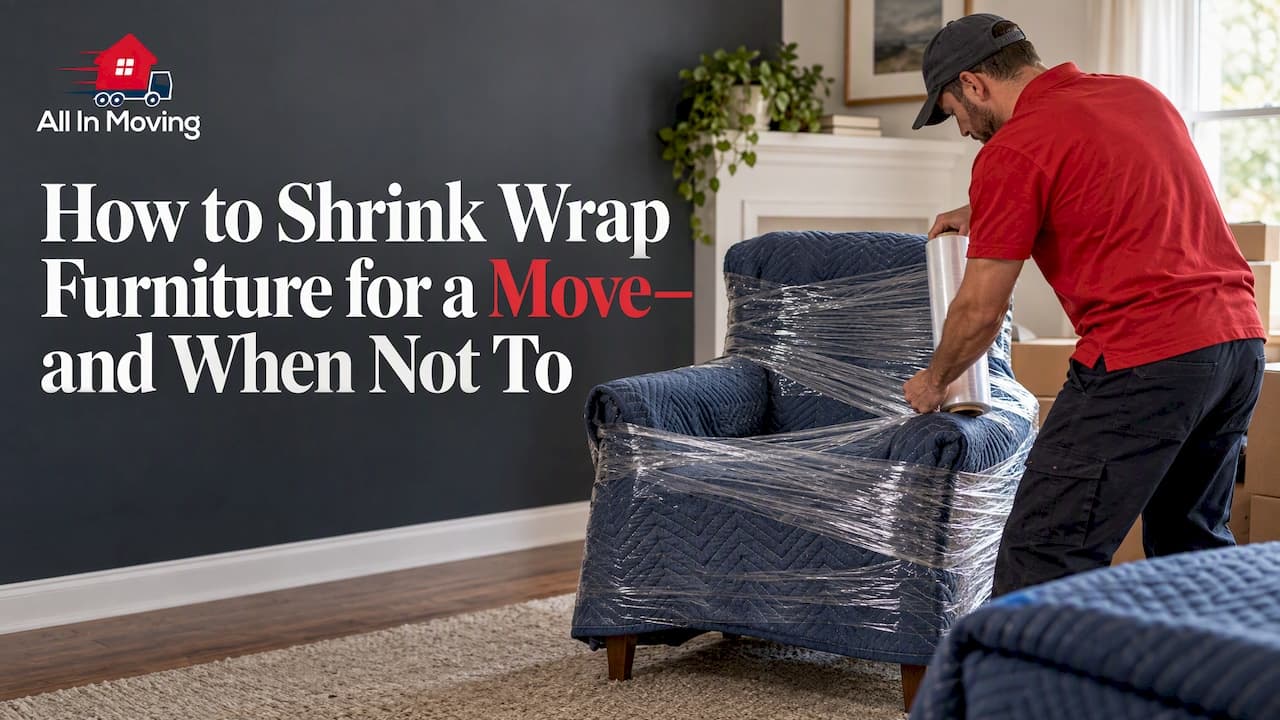
Most people who search for how to shrink wrap furniture for a move actually need stretch wrap. It's the clear, clingy film that sticks to itself and needs no heat. True shrink wrap is a different material. It tightens around an object under a heat gun, and it suits boats, outdoor sets and pallets better than a sofa headed down a highway. Either film keeps dust, moisture and scuffs off your furniture. Neither replaces padding, and on wood it can cause trouble if you wrap it wrong.
Below: which film to buy, how to apply it, what it costs, where it harms, how it compares with moving blankets, and how to cut the plastic you throw away.
TL;DR
- For a household move, use stretch wrap (also called plastic wrap or pallet wrap), not heat-activated shrink wrap. It's cheaper, needs no tools and comes off cleanly.
- Use plastic to hold blankets, drawers and doors in place and to keep upholstery clean. Put a moving blanket or pad under it for impact protection.
- Never wrap bare wood tightly or leave it wrapped for weeks in a humid space. Trapped moisture can cloud or stain the finish.
- A heavier gauge (80 is the common medium-duty choice) resists tearing better than thin kitchen-style film.
- Reusable blankets plus a little recyclable film is the lowest-waste combination that still protects your furniture.
Table of Contents
- Shrink wrap vs. stretch wrap: what you are really buying
- What plastic wrap does well, and what it can't do
- Does shrink wrap damage wood furniture?
- Choosing the right film: gauge, width and amount
- How to wrap furniture for moving, step by step
- Shrink wrap vs. blankets: which one protects better?
- How much does it cost to shrink wrap furniture?
- Greener ways to wrap and pack
- Perspective: how we think about wrapping
- When to hire professional packing instead
- A quick checklist before the truck arrives
- FAQ
- Sources
Shrink wrap vs. stretch wrap: what you are really buying
The two names get swapped constantly, even on retail sites. The difference matters on moving day.
Stretch wrap is a stretchy polyethylene film. You pull it tight by hand and it clings to itself. Stretch wrap is easier to use than shrink wrap because it doesn't require a heat gun. That is the product sold in 15 to 20 inch rolls with a handle, and it is what people mean by plastic wrap for moving furniture.
Shrink wrap is a film that tightens when heated. It makes a sealed, weatherproof skin. That's useful for winter storage of outdoor furniture, and for boats and RVs. A professional on-site residential service for outdoor sets is listed at $544 for up to 10 pieces, including materials and up to 1.5 hours of labor, with additional pieces at $13.50 each. That is a seasonal-storage product, not a moving one.
For a sofa, dresser or dining table, shrink wrap is the wrong tool for three reasons:
- It needs a heat source near upholstery, wood finishes and, often, a garage full of boxes.
- It seals the piece airtight, which is how moisture gets trapped.
- It has to be cut off, which risks slicing fabric or scratching a finish.
What plastic wrap does well, and what it can't do
Plastic wrap is a containment tool. It protects against the things that stain and snag:
- Dust and dirt on fabric and leather sofas, chairs and cushions
- Light moisture from a wet driveway or a quick rain shower between the house and the truck
- Drawers sliding open, cabinet doors swinging and removable shelves shifting
- Blankets slipping off a piece during loading
ConsumerAffairs notes that people mainly use plastic wrap to protect upholstered and large pieces from moisture, dirt and dust, and also to keep drawers closed and secure rolled-up rugs.
What it can't do is absorb a bump. A thin film will not stop a corner from denting a tabletop when a load shifts. The advice from U-Haul's packing guidance lines up with what experienced crews say: wrap is an outer layer that holds padding in place, not a stand-in for the padding.
Does shrink wrap damage wood furniture?
Not by itself, but how you use it matters. Wood is porous and reacts to humidity. A conservation guide from the Western Australian Museum describes how moisture trapped against wood in humid conditions can lead to finish blooming, staining or even fungal attack. That guidance is written for museum collections, but the physics is the same in a hot moving truck or a storage unit with no climate control.
A second source makes the same point from the storage side. One furniture-storage guide warns that plastic or bubble wrap applied too tightly can encourage condensation and does not recommend shrink wrap for storage. Treat that as a reason to keep plastic off bare wood for long periods.
Practical rules for wooden pieces:
- Pad first. Put a clean moving blanket or a breathable cover directly on the wood, then use plastic only to hold it.
- Keep it short. Plastic is fine for a transit window of days. For long storage, use breathable covers and let the piece sit in a stable, dry environment.
- Wait on fresh finishes. A newly refinished or waxed surface can stick to film. Give it the cure time the finish maker states.
- Unwrap promptly. When the truck is unloaded, take the plastic off in the room where the piece will live, so any moisture can escape.
Antique, veneered or high-value pieces deserve a conversation with a conservator or a furniture restorer before a long-distance move. If you suspect an infestation, Canada's Conservation Institute advises isolating the piece and wrapping it in plastic, then consulting a conservator. That is the one case where sealing is the point.
Choosing the right film: gauge, width and amount
Moving stretch wrap is graded by gauge, a measure of thickness. According to ConsumerAffairs, professional-grade film typically runs from 60 to 100 gauge:
| Gauge | Duty | Typical load rating |
|---|---|---|
| 60 | Light to medium | 1,600 lbs |
| 80 | Medium, the common standard | 2,400 lbs |
| 100 | Heavy duty | 3,000 lbs |
Those load ratings describe pallet loads. For household furniture, the useful takeaway is simple: choose 80 gauge for most pieces and don't use thin kitchen cling film on anything bulky. U-Haul warns that kitchen-style wrap is too light for bulkier items.
If you want to understand how thickness, color and pre-stretch affect performance, this German-language guide to stretch film selection criteria explains the logic businesses use when buying film. Pre-stretched film, for example, goes further per roll and is lighter on the hand.

How much film to buy
A 15 or 20 inch roll of 1,000 feet is the standard consumer size. A rough planning guide, based on what we see on our own jobs: a sofa and loveseat take a few dozen feet each when you wrap them fully, and a dresser takes less. Buy a roll for a one- to two-bedroom home and two for a larger house, since wrap left over is easy to use on the next move or to secure items in a closet.
How to wrap furniture for moving, step by step
- Clean and empty. Dust the piece. Remove loose items, cushions and glass shelves. Take out heavy contents from drawers, because weight can strain the joinery during transport.
- Disassemble what you can. Legs, shelves and mirrors come off. Bag the hardware and tape the bag to the piece, or use a labeled bag that travels in the cab.
- Pad the corners and faces. Drape a moving blanket over tops, sides and fronts. Use cardboard corner guards on sharp edges, and foam or cardboard on glass.
- Anchor the film. Start on the blanket, not on the bare finish. Walk the roll around the piece with moderate tension, overlapping each pass by about half.
- Lock the moving parts. Wrap drawers and doors shut across the whole front, keeping tension firm but not crushing. Don't tape the surface itself.
- Protect upholstery separately. On sofas and chairs, wrap directly on the fabric to keep dust and moisture off, then add a blanket over the plastic for impact protection.
- Lift from strong points. Conservation guidance says to carry pieces by sturdy structural points such as a table's apron or a cabinet's bottom rail, not by legs, arms or tops. It also warns that dragging puts severe stress on joints.
- Unwrap on arrival. Cut carefully with a blunt-tip tool, away from the surface, and check for scuffs while the crew is still there.
Shrink wrap vs. blankets: which one protects better?
The honest answer is that you want both, for different jobs.
| Moving blankets | Stretch wrap | |
|---|---|---|
| Impact protection | Good | Very little |
| Dust and moisture | Limited | Good |
| Breathability on wood | Good | Poor if tight and long-term |
| Holds drawers and doors | No | Yes |
| Reusable | Many times | Rarely |
| Cost per move | Low if reused | Low per roll |
Blankets absorb knocks and let wood breathe. Plastic keeps blankets from sliding and keeps upholstery clean. A piece wrapped in plastic alone looks protected and is not. A piece in blankets alone travels fine through a clean truck but can pick up grime on the curb.
How much does it cost to shrink wrap furniture?
There are three ways to pay, and the numbers differ enormously.
- DIY film. A roll of stretch wrap is a modest purchase at a hardware or moving-supply store. Prices vary by brand, width and gauge, so check the label for footage.
- Specialty shrink wrap service. The on-site outdoor furniture service mentioned earlier lists $544 for up to 10 pieces, $13.50 for each additional piece and $149 an hour for specialty packing labor. Those are 2026 listed prices for that provider and will differ by region.
- Packing by your mover. Many movers charge per item or per hour. The same provider page shows individual item surcharges commonly range from $10 to $130 depending on size and complexity. Ask any mover which pieces get wrapped, with what, and whether it is itemized.
With a long-distance move, the wrapping line is a small slice of the total. The bigger risk is the quote itself. If you're comparing, read how a binding estimate protects your long-distance moving cost and what binding estimates mean for payment at delivery on interstate moves.
Greener ways to wrap and pack
People looking for sustainable packing materials, recyclable moving boxes or eco friendly moving supplies are usually trying to stop a single-use pile of plastic. A few changes make a real difference without hurting protection:
- Reusable moving blankets first. Blankets, quilts, towels and bedding cover most of a furniture load. Use plastic only as the strap.
- Use less film, not different film. Wrap only what needs it: upholstery, drawers, doors. Skip full-body wrapping on pieces already in blankets.
- Choose recyclable film where you can. Some retailers sell recyclable polyethylene stretch film in moving-size rolls. Check what your local program accepts: many curbside programs do not take film, but some grocery stores collect plastic bags and wraps at drop-off bins. Call before you assume.
- Rent or borrow plastic crates and wardrobe boxes for the household goods, and reuse corrugated boxes. Cardboard is widely recycled, so recyclable moving boxes are the easiest swap. Flatten and pass them on, or recycle them after unpacking.
- Roll the leftover film. Keep a partial roll for the next move or for covering paint cans and rugs.
Perspective: how we think about wrapping
We run long-distance and international moves with one dedicated team from the first estimate to delivery. We don't hand your furniture to a broker or a subcontractor. That changes how we think about wrap.
A piece is only as protected as the weakest link in the chain, and the chain is long on a cross-country move. A sofa can sit for days in a warehouse or a truck through different climates. So we treat plastic as one layer in a system: padding for impact, plastic to keep the padding on and the dust off, and a plan for unwrapping soon after delivery.
What we tell customers is plain. Don't shrink wrap a wooden table airtight because it feels thorough. Don't skip blankets because a roll of film is cheap. And ask any mover how it handles wood and upholstery before you sign, not after.
— Sami
When to hire professional packing instead
DIY wrapping works for a studio or a one-bedroom across town. It gets harder when:
- You're moving across several states or abroad, with more handling and more time in transit.
- You own heirloom, antique or veneered pieces, glass tops and large sectionals.
- The move happens in extreme heat, cold or humidity.
- You'd rather spend the weekend with family than with a roll of film.
Our crews handle packing along with logistics coordination, and for international moves we also take care of customs clearance. If you want your estimate to cover the wrapping, ask for it in writing as part of a binding estimate, so the number you see is the number you pay. Start with our residential and commercial moving services or, if you're relocating overseas, international moving. You can also read what customers say in our reviews.
Related reading if you're packing other fragile items: bagging a mattress so it arrives clean and dry, and moving with plants.
A quick checklist before the truck arrives
- Roll(s) of 80 gauge stretch wrap, 15 or 20 inches wide
- Enough moving blankets for every wooden piece, plus extras for the sofa and mattress
- Corner protectors and cardboard for glass and mirrors
- Labeled bags for hardware, taped to the furniture or kept with you
- Blunt-tip cutter for unwrapping
- Plan for where leftover film, cardboard and blankets go after the move
FAQ
Can I use shrink wrap on a sofa for moving?
You can, but stretch wrap is the better choice. Heat-activated shrink wrap needs a heat gun near fabric and creates an airtight seal. Stretch wrap does the same dust and moisture job by hand, and you can pull it off cleanly at delivery.
Does plastic wrap damage wood furniture?
Not when it's used briefly and over padding. Problems come from tight plastic touching bare wood in humid conditions for long periods, which can trap moisture and cause blooming or staining on the finish. For storage, use breathable covers instead.
What is better for moving furniture, blankets or plastic wrap?
Blankets protect against impact, and plastic holds them in place and blocks dust. Together they work. Plastic alone leaves corners and faces exposed to knocks.
How much does it cost to shrink wrap furniture?
It depends on the route. A DIY roll of stretch wrap costs far less than a specialty service, which for one listed provider starts at $544 for up to 10 outdoor pieces. Movers often itemize wrapping by piece or by the hour, so ask for it in writing.
How do I make furniture wrapping more eco friendly?
Use reusable blankets for most of the work, wrap only what needs it, and choose recyclable film if your local drop-off program accepts it. Recycle cardboard boxes after the move.
Sources
- Stretch wrap guide, Air Sea Containers
- Residential Furniture Shrink Wrap Service
- How to use plastic wrap for moving, ConsumerAffairs
- 7 Ways to Use Plastic Stretch Wrap for Moving, U-Haul
- Preventive Conservation, Western Australian Museum
- Basic care: Furniture and objects made of wood, Canada.ca
- Recyclable stretch wrap film listing, Amazon