
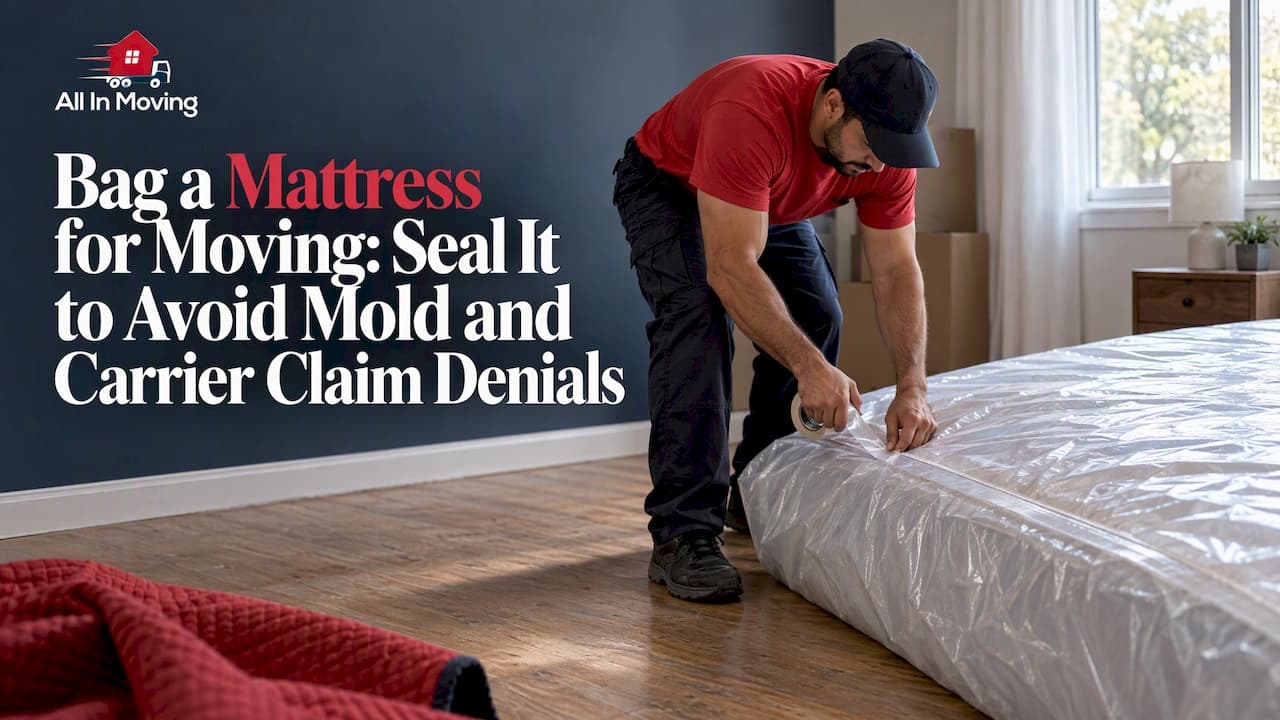
Yes: use a heavy-duty, correctly sized mattress bag, dry the mattress fully first, and seal or reinforce the opening to block moisture and prevent transit damage. Clean the surface, let it air-dry completely, slide it into a bag rated for its size, then tape or seal every seam. Carry it with a second person and load it flat or upright against the truck wall, never folded or forced.
TL;DR:
- Use a heavy-duty, 4-mil polyethylene mattress bag that is correctly sized and fully sealed only after the mattress is completely dry to prevent mold and moisture damage.
- Ensure the mattress is thoroughly cleaned, vacuumed, and air-dried for several hours before bagging to avoid trapping residual dampness that can cause mold growth.
- Seal the bag with double adhesive strips or heavy-duty packing tape, and reinforce seams to protect against tears, especially during long-distance transport.
- Handle the mattress with two people, load it flat or upright against the truck wall, and avoid folding or forcing it into a bag that is too small.
- For oversized or specialty mattresses, measure accurately, select appropriately sized bags, and bag components like box springs separately to prevent damage.
Table of Contents
- What you need: mattress bag types, sizes, and materials
- Step-by-step: how to bag a mattress safely (two-person method)
- How to seal and reinforce the bag to block moisture, pests, and transit damage
- Special considerations by mattress type
- Loading, transport, and storage: handling a bagged mattress on moving day
- Practitioner perspective: real-move lessons and common mistakes
- Handling mattresses of unusual sizes or shapes
- What actually matters when you bag a mattress for a move
- How All In Moving protects your mattress on a long-distance move
- FAQ
- Sources
- Selected product and guidance pages referenced
What you need: mattress bag types, sizes, and materials
Not every mattress bag does the same job. The gauge, closure, and overall size decide whether your mattress arrives clean and dry or picks up rips and moisture along the way.
Heavy-duty bags, usually around 4-mil polyethylene, hold up far better than the thin plastic sleeves some stores toss in for free. The Linenspa King Heavy Duty Mattress Storage Bag is built from 4-mil polyethylene with a closure flap and double adhesive strips designed to keep out dirt, pests, and moisture during a move or storage stretch. Thinner poly bags and breathable fabric covers work fine for short trips across town but tear easily when a mattress gets dragged up stairs or jammed into a truck.
Closures vary by brand. Adhesive-flap bags let one person seal the opening without extra supplies. Open-end bags are cheaper but need heavy packing tape to close properly, and a few vendors sell shrink-wrap style options, though those are rarely practical for a mattress the size of a full bed.
A few features are worth paying for:
- Vent holes, which some heavy-duty bags include specifically to reduce mold and mildew risk during longer storage periods.
- Built-in handles, which make a two-person carry noticeably easier and cut down on grip-related tears.
- Oversized dimensions, since a pillow-top or a thick king mattress needs more room than a standard-depth bag provides.
Prices for a solid mattress bag typically run somewhere in the $8 to $20 range depending on size and where you buy it, based on municipal disposal guidance that lists common retail sources and price ranges for waterproof mattress bags. You'll find them at big-box home stores, dedicated moving-supply shops, and online retailers that specialize in moving and storage gear.
Step-by-step: how to bag a mattress safely (two-person method)
Getting a mattress into a bag without tearing the plastic or straining your back comes down to prep and technique, not brute force.
Start with the mattress itself. Strip off all bedding, vacuum both sides to remove dust and debris, and spot-clean any stains. This is the part people skip, and it's the one that matters most: a mattress that isn't fully dry before it goes into a sealed bag creates a mold risk once it's wrapped in plastic for days or weeks, according to moving guidance from 1-800-PACK-RAT. Give it several hours in open air, longer if you used any cleaning solution, before moving to the next step.
Once it's dry, follow this sequence:
- Lay the bag flat on the floor or bed surface and open it fully.
- Position the mattress on its edge, lining up the narrower end with the bag's opening.
- With one helper steadying the mattress and another guiding the bag, tilt and slide the mattress in using a smooth, continuous motion rather than short jerky pushes.
- Work the bag up over the mattress in sections, smoothing out wrinkles as you go so the plastic doesn't bunch and tear at a corner.
- Once fully covered, check all four corners and the full length of the opening for gaps before sealing.
If the mattress feels tight going in, don't force it or try to fold the mattress to make it fit. Ease one corner in first, then work the opposite corner, alternating side to side until the bag slides up naturally. A bag that's genuinely too small needs to be swapped for a larger size rather than stretched past its limit.
Before sealing, run your hand along the full bag looking for existing tears or weak spots, then align the closure flap or open end evenly.
Pro Tip: Fold the excess plastic at the open end inward before taping, so the tape grips plastic-to-plastic rather than plastic-to-mattress fabric.
How to seal and reinforce the bag to block moisture, pests, and transit damage
Sealing is where most of the protection either holds or fails. The core rule stays the same across every bag type: never seal a mattress that isn't completely dry, since trapped moisture inside a plastic barrier is the most common cause of mold showing up days later, per 1-800-PACK-RAT's mover guidance.
A notable share of mattress damage claims on long-distance moves trace back to inadequate sealing rather than rough handling, according to the same moving tips resource, which notes that carriers often deny soiling or moisture claims when a mattress bag was missing or improperly sealed.
Your sealing method depends on the bag you bought:
- Adhesive-flap bags, like the Linenspa model mentioned above, seal with their built-in double adhesive strips, no extra tape needed if the strips stay clean and dry.
- Open-end bags require heavy-duty packing tape run along the entire seam, doubled at the corners where stress concentrates.
- Any bag benefits from a second pass of tape over the main seam for a move longer than a day or two.
For extra protection on rougher trips, a layer of moving blankets wrapped around the bagged mattress adds abrasion resistance against truck walls and straps. Full shrink-wrap is rarely necessary and mostly impractical at mattress scale, but reinforced tape on every seam does the same job for a fraction of the effort.
If you're shipping long-distance or using freight service, movers often double-bag a mattress or place the sealed bag inside a reinforced mattress box, since carriers inspect packaging at pickup and will note improper sealing against any later damage claim.
Special considerations by mattress type
Different mattress constructions need different handling, and the wrong move can void a warranty or cause damage that's hard to spot until the mattress is back in use.
- Memory foam: Avoid vacuum-compressing or folding it unless the manufacturer explicitly allows it. Most memory foam mattresses ship compressed only once, at the factory, and attempting it again at home risks permanent damage to the foam structure. Use an oversized bag and handle it with padded support rather than bending it to fit.
- Innerspring and pillow-top: These need a thicker, heavy-duty bag since the coil structure and extra padding make them bulkier and more prone to snagging thin plastic. Never fold an innerspring mattress; the coils can shift or break under a tight bend.
- Box springs: Measure and bag separately from the mattress. Box springs have their own dedicated bags sized for their flatter profile, and combining them with the mattress in one oversized bag usually leads to a poor fit on both ends.
- Measuring for the right size: Measure length, width, and thickness at the mattress's thickest point, including any pillow-top layer, then match that figure against the bag's listed dimensions rather than just matching "queen" to "queen," since thickness varies a lot between models.
Loading, transport, and storage: handling a bagged mattress on moving day
Once the mattress is bagged and sealed, how you carry and place it matters almost as much as the bag itself.
- Lift with a partner using a steady, coordinated motion, bending at the knees rather than the back, and consider mattress-carrying straps if you're moving it any real distance.
- Load the mattress flat on top of other items if the truck has room, or upright and secured against the truck wall if space is tight, since either position works as long as it's not bent or wedged under heavy furniture.
- Secure it with moving straps or rope so it can't shift and rub against rough truck surfaces during transit.
- Keep it off wet truck beds or exposed trailer floors where water pooling is a risk, and never let a bagged mattress sit directly on concrete in storage, since concrete holds moisture that can seep through even a sealed bag over time.
If the mattress is headed into storage rather than straight to a new home, check that the bag's vent holes, if it has them, aren't blocked by other boxes, since airflow around a stored mattress reduces the odds of trapped humidity turning into mildew. For longer storage stretches, our partners at Island Park Storage publish practical guidance on keeping stored items off concrete and maintaining airflow in a storage unit, which applies directly to a bagged mattress sitting for weeks or months.
Practitioner perspective: real-move lessons and common mistakes
Across long-distance moves, the same handful of mistakes keep showing up. Sealing a mattress that's still damp from cleaning is the most frequent one, followed closely by using a thin bag meant for short-term storage on a cross-country trip, and taping seams loosely enough that they peel open during loading.
The fixes are simple but easy to skip under time pressure. Double-bagging adds a real margin of safety on multi-day hauls. Taping every seam, not just the obvious opening, catches the weak points that tend to fail first. For long-distance or freight-style shipments, a reinforced mattress box around the sealed bag gives it structure that plastic alone can't provide.
On our own moves, the checklist is straightforward: confirm bag dimensions against the actual mattress before sealing, inspect the bag for tears right before loading, and document the mattress condition at pickup so there's no ambiguity later if a client has a question about how it traveled.
Handling mattresses of unusual sizes or shapes
King-size mattresses, split king setups, and adjustable bases all need a bit more planning than a standard queen.
A king mattress needs a bag sized specifically for king dimensions, not a queen bag stretched to fit, since the extra width means a too-small bag will tear at the seams during loading. Split king mattresses, which are really two twin XL mattresses, should be bagged separately, each sealed on its own rather than crammed into one oversized bag together.
Adjustable bases complicate things further because the base itself usually isn't meant to bend or fold during a move. The mattress on top gets bagged the same way as any other mattress, but the base underneath typically needs to be disconnected from power and moved flat, often in its own protective wrap rather than a mattress bag. If the base has a hinge point, keep it in its flattened position during transport rather than letting it fold under its own weight, which can stress the motor and frame.
For any oversized or irregular mattress, measuring before you shop for a bag saves a return trip. Add a couple of inches to your actual measurements when choosing a bag size, since a snug fit increases the odds of tearing during the slide-in step.

What actually matters when you bag a mattress for a move
Most advice on this topic focuses on the bag itself, as if buying a thicker one solves everything. It doesn't. The bag is only as good as the prep work before it and the sealing after it, and that's where most damage and most mold problems actually start.
Drying time gets treated as an afterthought, a quick "let it air out" line tucked at the end of a checklist. It should be the first priority, not the last. A $20 heavy-duty bag sealed around a mattress that still has residual dampness from cleaning does more harm than a $10 bag on a bone-dry mattress, because the plastic barrier traps whatever moisture is already there.
The other overrated step is vacuum-compressing. Most consumer attempts at compressing a mattress at home either fail to create a real seal or risk damaging the mattress structure, memory foam especially. Skip it. Spend that effort on reinforcing seams and checking the bag for tears instead, since that's where real protection comes from on a move of any real distance.
— Sami
How All In Moving protects your mattress on a long-distance move
We handle the packing and the protection ourselves, with a dedicated team managing the move from pickup to delivery. That matters most on a long-distance or international move, where a mattress sits in transit for days rather than hours.

When you request a quote, ask for packing and protection as a line item so your mattress, along with anything else that needs extra care, is covered under the same binding estimate. Our estimates are transparent and binding to help avoid unexpected fees.
- Professional packing handled by our own crew, not a third party.
- Door-to-door service for long-distance and international moves.
- Binding, transparent pricing agreed upfront.
If you're planning a move and want your mattress and the rest of your home handled by one team start to finish, request a binding estimate from All In Moving and ask about packing and protection options for your specific move.
FAQ
What is the best way to transport a mattress?
The best approach is a heavy-duty mattress bag sized correctly for your mattress, sealed only after the mattress is fully dry, with seams reinforced using heavy packing tape for longer trips. Carry it with two people and load it flat or upright and secured inside the moving vehicle.
What is moving in my mattress?
This usually refers to the process of wrapping and transporting your existing mattress to a new home rather than buying a new one. It involves cleaning the mattress, letting it dry fully, bagging it in a protective cover, and loading it carefully to avoid tears or moisture damage during the move.
Does U-Haul offer mattress covers?
Moving supply retailers, including U-Haul locations, commonly sell mattress bags and covers sized for twin through king mattresses. Availability and specific product lines vary by location, so it's worth checking with a specific retailer or moving-supply store before your move date.
What type of mattress bag should I use for moving?
A heavy-duty bag, often around 4-mil polyethylene, with either an adhesive-flap closure or an open end you reinforce with packing tape. Look for one sized specifically for your mattress type, since a queen bag and a king bag differ enough that a snug fit increases tear risk.
Sources
Selected product and guidance pages referenced
These sources cover mattress bag specifications, closure types, and the moisture-prevention guidance referenced throughout this article, including gauge thickness, vent hole features, and mover recommendations on drying before sealing.