
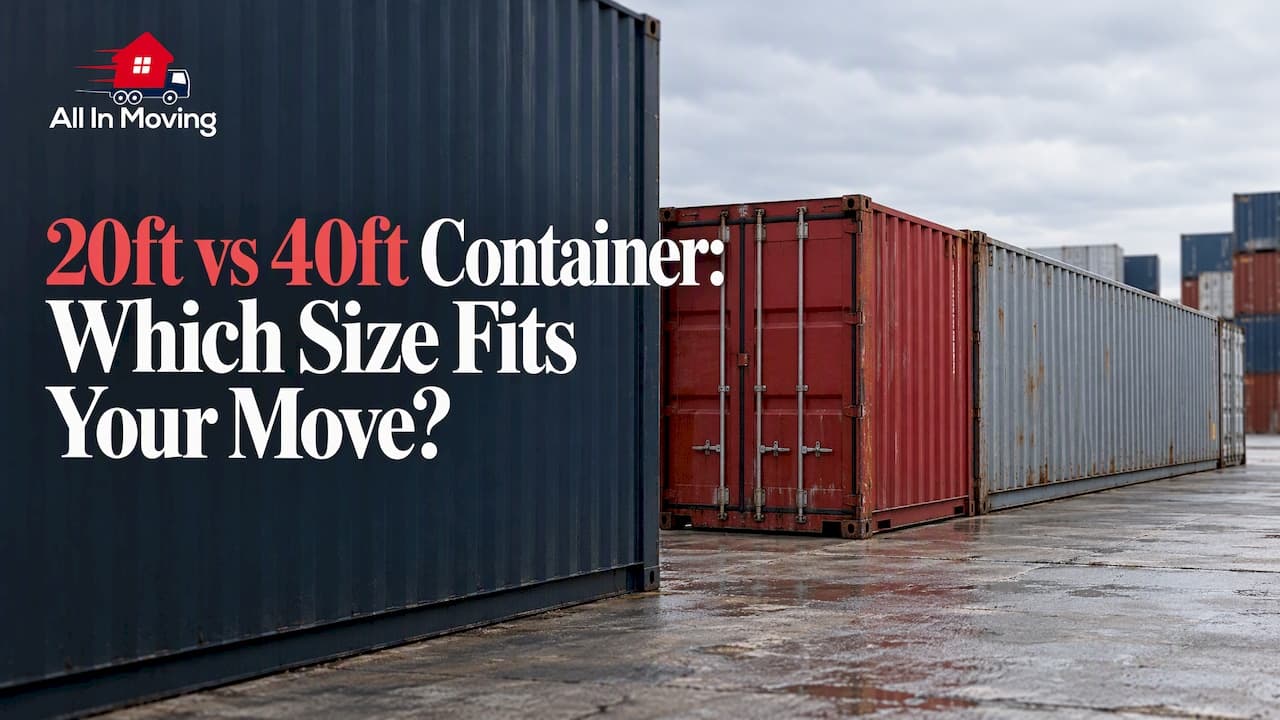
A 40ft container holds roughly twice the volume of a 20ft, but it rarely costs twice as much, so for a full household the 40ft usually wins on cost per cubic foot. The 20ft wins when your shipment is small, dense or heavy, or when the truck has to reach a tight street. The right answer depends on how much space your belongings fill, not how much they weigh, and that is where most people get tripped up.
This guide covers the real dimensions, how carriers bill volume against weight, what the price gap looks like, and a simple way to decide before you ask anyone for a quote.
TL;DR
- A 20ft container holds about 1,172 cubic feet inside. A 40ft holds about 2,389, and a 40ft High Cube about 2,694.
- Household goods are bulky and light, so they fill space long before they hit weight limits. That favors the 40ft for a full home.
- A 20ft often costs 60 to 70 percent of a 40ft while giving about half the space, so the larger box is usually cheaper per cubic foot.
- The 20ft is the practical choice for small loads, dense cargo and homes where a long truck cannot park or turn.
- Choose from a survey of your actual inventory, then confirm the container has a valid safety approval plate.
Table of Contents
- The dimensions and capacity side by side
- What actually fits in each
- Volume versus weight: why bulky moves favor the 40ft
- Cost: why double the space is not double the price
- Access matters as much as the math
- Safety checks that apply to both sizes
- How to choose: a short decision path
- Our perspective: size the load, then lock the price
- Moving abroad? Start with the right size
- FAQ
- Sources
The dimensions and capacity side by side
Both sizes are standard, which is why every port, ship and trucking network can handle them. According to Kuehne+Nagel's container guide, a 20ft container measures 5.9 m by 2.35 m by 2.39 m inside (about 19.4 by 7.7 by 7.8 feet), and a 40ft measures 12.03 m by 2.35 m by 2.39 m (about 39.5 feet long). The same guide gives capacity of roughly 33 cubic meters (1,172 cubic feet) for the 20ft and 67 cubic meters (2,389 cubic feet) for the 40ft. The 40ft High Cube adds a foot of height and reaches about 76 cubic meters (2,694 cubic feet).
| 20ft standard | 40ft standard | 40ft High Cube | |
|---|---|---|---|
| Internal length | about 19.4 ft | about 39.5 ft | about 39.5 ft |
| Internal width | about 7.7 ft | about 7.7 ft | about 7.7 ft |
| Internal height | about 7.8 ft | about 7.8 ft | about 8.8 ft |
| Capacity | about 1,172 cu ft (33 m³) | about 2,389 cu ft (67 m³) | about 2,694 cu ft (76 m³) |
| Empty (tare) weight | about 2,300 kg (5,070 lb) | about 3,750 kg (8,270 lb) | similar to the 40ft |
Tare weights come from the same Kuehne+Nagel overview. The High Cube tare is not listed there, so treat it as roughly in line with the standard 40ft and ask for the exact figure.
Two details matter more than they look. First, the two boxes have the same width and the same standard height, so a 40ft is essentially two 20fts placed end to end. Second, you can only load what fits through the door and between the walls. A tall armoire or a large sectional is limited by the 7.8 ft interior height, not by the length of the box.

What actually fits in each
We will not hand you a magic number such as "a two-bedroom fits in a 20ft", because the real answer swings with furniture size, how much is in the garage and whether you pack in boxes or ship loose items. What we can say from the capacity figures is this: a 20ft is a good match for a studio or small apartment, a modest one-bedroom, or a partial load of a larger home, such as a vehicle plus a few rooms. A 40ft is where full family homes, large furniture sets and heavy garage contents end up.
A few ways to reality-check your volume:
- Walk each room and list every large item, including what lives in the attic, basement, garage and shed.
- Mark what you will sell, donate or leave behind. Volume you do not ship is the cheapest volume there is.
- Remember that boxes cannot be stacked into every gap. Odd-shaped furniture wastes space, and a good crew spends real time loading efficiently.
- Ask whether the load fits comfortably or only if everything goes perfectly. A load that barely fits in a 20ft is a load that belongs in a 40ft.
If your home is in the gray area, our guide to household goods weight and why the garage counts shows how easily the forgotten spaces add up.
Volume versus weight: why bulky moves favor the 40ft
Most people assume shipping is priced by weight. For an international household move it is more nuanced. DHL's explanation of chargeable weight describes the "whichever is greater" principle: the carrier looks at actual weight and at the space the cargo occupies, and charges on the larger of the two.
Household goods are mostly mattresses, sofas, bedding, clothes, boxes of kitchenware and bookcases. They take up a lot of room and weigh comparatively little. Their volume reaches the limit of the container long before their weight does, so for a home move the space is what you are really buying. That is why volume-based pricing is the norm for household shipments.
The flip side is dense cargo. Machine tools, stacked books, a home workshop or a collection of stone and metal can use a 20ft's weight capacity while leaving the space half empty. According to the Maersk guide to container sizes, the standard 20ft is designed to carry more weight than voluminous cargo. If your shipment is tool-heavy rather than furniture-heavy, the 20ft can be the better fit even when the volume suggests otherwise.
A useful test: picture your shipment. If it looks like a big pile of soft, awkward shapes, you are volume-limited. If it looks like a few pallets of heavy things, you are weight-limited.
Cost: why double the space is not double the price
A 20ft costs less than a 40ft, but not half as much. Hansatic's container guide reports that a 20ft typically runs about 60 to 70 percent of the cost of a 40ft while offering only about 49 percent of the volume. Fixed charges such as handling at the port, documentation and the trucking leg do not shrink in proportion when the box gets smaller, so the larger container spreads them across more cubic feet.
Here is a worked example with made-up round numbers, only to show the logic. Say a 40ft costs 100 units and a 20ft costs 65. The 40ft gives you about 2,389 cubic feet, roughly 0.042 units per cubic foot. The 20ft gives you 1,172, about 0.055 per cubic foot. If you would need 1,500 cubic feet, you are paying for a 40ft anyway, and putting the load into two 20fts would cost around 130 units for a result you could have had for 100.
The reverse also holds. If your goods fill 900 cubic feet, a 20ft with some room to spare is cheaper than a mostly empty 40ft. Do not pay for air.
Actual prices vary with route, season, fuel, port fees and whether you ship door-to-door or port-to-port. For a sense of the full picture beyond the box, read our breakdown of international moving costs and a four-step budget.

Access matters as much as the math
A container does not teleport to your living room. It arrives on a truck, and a 40ft trailer is a long vehicle. Container xChange notes that a 20ft is often more practical for home moves on residential streets with restricted access, where a large 40ft rig cannot safely maneuver or park. They also advise verifying site accessibility before settling on a 40ft.
Check these before you decide:
- Street width and turning room. Dead-end streets, tight cul-de-sacs and steep driveways can rule out a long trailer.
- Overhead obstacles. Low branches, wires and bridges on the approach.
- Parking permits. Many cities require a permit and a reserved curb for a large truck. Ask your city or HOA about the rules for your block.
- Loading time. A bigger box takes longer to load and may need more crew hours.
- Building rules. Condos and apartment towers often limit truck size and loading windows, and may require a certificate of insurance.
If access is tough, there are options: a shuttle vehicle that carries goods from the house to the larger truck, or splitting the load into a smaller container. A professional survey will flag this before it becomes a problem on moving day.
Safety checks that apply to both sizes
Containers in international trade fall under the International Convention for Safe Containers (CSC). The UK Maritime and Coastguard Agency's information note on container examination explains that containers must be regularly examined, and describes the Approved Continuous Examination Programme (ACEP), under which inspections take place during maintenance, repairs or interchanges, with no more than 30 months between them. The practical takeaway for you: a container should carry a valid safety approval plate. If you are involved in selecting or inspecting the box, look for it, and also check for floor damage, door seals that close properly and signs of water ingress. Damp or a musty smell can ruin upholstery and electronics on a multi-week ocean voyage.
How to choose: a short decision path
- Measure your volume. Use a professional in-home or video survey rather than guessing from the number of bedrooms.
- Compare to capacity. Under roughly 1,000 cubic feet of goods suggests a 20ft. Above roughly 1,800 suggests a 40ft. In between, price both and keep some headroom for packing material. These thresholds are our working guide, not an industry rule, and the survey decides.
- Weigh the weight. If your goods are dense (tools, books, stone, equipment), confirm the load stays within the container's payload limit and check how chargeable weight will be applied.
- Check access. Confirm that a long trailer can reach your door at origin and at destination.
- Decide on a High Cube. If you own tall furniture or want a little extra volume, a 40ft High Cube adds about 300 cubic feet over the standard 40ft.
- Ask for a binding estimate. The container size is only one line in the quote. What matters is the final number and what it includes.
If you are also planning timing, our long-distance moving checklist lays out what to do eight weeks out, and storage in transit explains what happens if your destination is not ready when the container lands.
Our perspective: size the load, then lock the price
We handle long-distance and international moves with one dedicated team from start to finish, and no brokers or handoffs along the way. The container question comes up constantly, and our view is simple.
First, most people underestimate their volume and overestimate their weight. Garages, closets and storage units are where a 20ft plan quietly turns into a 40ft reality. Count them early.
Second, the cheapest container on paper is not always the cheapest move. If a load barely fits, you risk leaving things behind or paying for a second shipment. We would rather see a customer in the right-sized box with a little room to spare.
Third, the size you choose should show up in a binding estimate, not in a vague range. When the estimate reflects the actual cost, there are no hidden fees waiting at the port or the delivery address. That is the standard we hold ourselves to, and the one we suggest you ask of anyone you consider.
Fourth, international moves involve customs paperwork, and that is where a single team that knows your inventory pays off. The same people who packed your boxes can answer questions about what is inside them.
— Sami
Moving abroad? Start with the right size
If you are planning an overseas relocation and want the container question settled by someone who will also pack, coordinate logistics and handle customs clearance, see our international moving service. You get a binding estimate and one team accountable for the whole move. For domestic and office relocations, start from allinmoving.net.
FAQ
Is a 40ft container twice as big as a 20ft?
In length, yes: about 39.5 ft inside against about 19.4 ft. In capacity it is a little more than double, roughly 2,389 cubic feet against 1,172, according to Kuehne+Nagel. Width and standard height are the same.
Can two cars fit in a 20ft container?
Usually not. The 20ft is about 19.4 feet long inside, so one average car fits with little left over, and two cars generally call for a 40ft. Exact fit depends on the vehicles, so confirm with your mover. If you are shipping a vehicle on its own, see our guide to shipping a car with one team.
Is it cheaper to ship one 40ft or two 20fts?
Often the single 40ft, because a 20ft tends to cost 60 to 70 percent of a 40ft while providing only about half the volume, per Hansatic. Two 20fts also mean two sets of handling and trucking. Exceptions exist when two separate destinations or access limits make a split sensible.
Do I pay for weight or for volume on an international move?
Carriers apply the greater of the two, as DHL explains. Household goods are bulky and light, so volume usually drives the price. Very dense shipments can be weight-driven.
Sources
- Kuehne+Nagel: Overview of container types and sizes
- Hansatic: Container dimensions guide
- DHL Global Forwarding: Calculating chargeable weight
- Maersk: A guide to shipping container sizes and types
- Container xChange: 20ft and 40ft shipping containers
- Maritime and Coastguard Agency: Marine Information Note on container examination