If your move involves a few rooms of furniture rather than a full house, consolidated or freight-based shipping is usually the cheapest route, while full-service dedicated moving costs more but locks in your delivery date. All In Moving is a direct option worth considering when you want one team handling packing, transport, and customs from start to finish with a binding estimate. The choice comes down to a simple trade-off: save money and accept a delivery window, or pay more for certainty and hands-off service.
TL;DR:
- Consolidated freight offers a lower-cost option for small moves by sharing truck space but results in a wider delivery window than full-service options.
- Full Value Protection is recommended for high-value or irreplaceable items, as Released Value may pay insufficient compensation based on weight alone.
- A single dedicated team reduces the risk of damage and miscommunication, which is especially important for fragile or specialty items in small shipments.
- International moves require detailed customs documentation, including packing lists and import permits, and should be coordinated with experienced movers to avoid delays.
Table of Contents
- Service models for small loads and when each one fits
- How small-load moves work from pickup to delivery
- What drives small load moving costs and how to compare quotes
- Insurance, liability, and valuation options explained
- Inventory, packing, and documentation checklist
- International small-load moves: customs and documentation
- Timeline trade-offs: consolidation versus dedicated service
- Handling fragile and specialty items in small load moves
- Why a single dedicated team changes the risk profile of a small move
- All In Moving: a direct, single-team option for small long-distance moves
- FAQ
- Sources
Service models for small loads and when each one fits
Before comparing quotes, you need to know what you're actually buying. Movers rarely explain which service model they're selling, and the differences change your price, your timeline, and how much work falls on you.
Full-service, dedicated moving means one truck, one crew, and a fixed pickup and delivery date. The company packs, loads, drives, and unloads without stopping at a terminal to combine your goods with other customers' shipments. This model costs more per pound because you're paying for a dedicated vehicle and crew, but it gives you control over timing and reduces the number of people who touch your belongings.
Consolidated freight, sometimes marketed as partial-load or small-shipment moving, groups your items with other customers' loads heading in a similar direction. A FreightWaves report on small-load movers found that this approach lowers transport cost because you're sharing truck space, but it widens your delivery window since the driver needs to fill the truck or complete other stops first. This model suits anyone without a hard deadline.
Container-based moving puts your belongings in a portable container (wood crate or steel unit) that you load yourself, or with hired labor, and the company transports it on their schedule. You trade labor for savings: loading and unloading falls on you, but the per-pound rate tends to be lower than full-service.
Labor-only moving covers just the physical work, loading, unloading, or in-home rearranging, while you arrange your own transport, such as a rental truck or a freight service. It fits local or short moves where the real cost is sore backs, not mileage.
Here's how to match your situation to a model:
- One or two large items (a couch, a piano, an appliance): freight shipping usually costs less than hiring a full crew for a near-empty truck.
- Many small to medium boxes with no fragile furniture: a container or consolidated service balances cost and convenience.
- A studio or one-bedroom apartment with normal household goods: consolidated freight is often the sweet spot between price and service.
- High-value, fragile, or antique furniture, or a hard delivery deadline: dedicated full-service moving is worth the premium.
- A local move within driving distance where you already have a truck: labor-only service covers the heavy lifting without paying for transport you don't need.
Watch for how a sales rep describes the service. If they talk about "your truck" and a fixed date, you're looking at dedicated service. If they mention "space available," "consolidated routing," or a delivery window measured in days rather than a single date, you're buying freight-style capacity. Neither is better by default, but the price difference should match the service difference. A quote that promises freight-level pricing with dedicated-truck guarantees is a sign to ask more questions before signing anything.
How small-load moves work from pickup to delivery
Once you've picked a service model, the mechanics of a small-load move follow a fairly standard sequence, though the details shift depending on whether your goods travel alone or alongside other shipments.
- Order for service. Before anything is loaded, a legitimate interstate mover prepares a written order for service and a dated estimate. FMCSA's rules on estimating charges require this document to cover transportation, accessorial, and advance charges, and to state clearly whether the estimate is binding or non-binding.
- Origin weighing. For moves billed by weight, the truck is weighed empty before loading and again after your goods are on board. The difference is your shipment's weight, which drives the final charge on a non-binding estimate.
- Loading and inventory. The crew documents each item's condition before loading, creating the paper trail you'll need if something arrives damaged.
- Routing. On a dedicated move, your truck drives directly to your destination. On a consolidated shipment, your goods may sit at a terminal until the truck has enough volume to justify the route, which is what creates the wider delivery window freight customers accept in exchange for lower cost.
- Destination weighing and reweigh rights. The truck is weighed again at delivery. If you believe the billed weight is inflated, FMCSA's rules on pickup and delivery give you the right to request a reweigh before paying.
- Delivery and payment. On a binding estimate, you pay the quoted price unless you added services. On a non-binding estimate, FMCSA permits movers to collect up to 110% of the original estimate at delivery, with the remainder billed later.
Accessorial charges, the fees for anything beyond basic transport, are where small-load quotes often go wrong. Stair carries, long carries from the truck to your door, bulky-item handling, and third-party elevator or shuttle service all carry separate line-item fees. Before you book, ask the company to define every accessorial charge in writing and confirm which ones apply to your specific home. A quote that looks cheap on paper can balloon at delivery if these charges were left out.
What drives small load moving costs and how to compare quotes
Price on a small load moving job comes down to a handful of variables, and understanding them lets you compare quotes that otherwise look like apples and oranges.
- Distance. Interstate pricing scales with mileage, though small shipments often carry a minimum charge regardless of how short the trip is.
- Weight or cubic volume. Freight and consolidated services typically price by weight or by the space your goods occupy in the truck, whichever the carrier uses to bill.
- Accessorial services. Stairs, long carries, bulky items, and disassembly or reassembly each add a separate fee.
- Packing materials and labor. Professional packing costs more than packing your own boxes but reduces damage risk and claims.
- Valuation coverage. Full Value Protection costs more than the minimum Released Value coverage but pays out at replacement value.
- Storage. If your delivery date doesn't line up with your move-out date, in-transit storage adds a daily or monthly fee.
- Fuel surcharges. Some carriers adjust pricing based on current fuel costs, especially on longer routes.
One way to apply the consolidation trade-off: FreightWaves reporting on small-load movers describes consolidation as lowering transport cost while widening delivery windows, a trade-off worth weighing against your own schedule flexibility before you commit to either model.
Non-binding estimates are where costs tend to drift. Because they're based on an estimated weight before loading, the final bill can change once your goods are actually weighed. FMCSA's guidance on estimating charges allows movers to collect up to 110% of a non-binding estimate at delivery, with any remaining balance due later, so a non-binding quote isn't a price ceiling, it's a starting point.
To build your own estimate range, ask each mover for the same inputs: estimated weight or volume, mileage, a full list of accessorial charges that apply to your home, the valuation option you want, and whether storage is likely. Say your shipment weighs an estimated 1,500 pounds and the mover quotes a per-pound rate plus a flat accessorial fee for a second-floor walk-up. Run the same math across two or three quotes using the same weight assumption, and you'll see which company's base rate is actually lower, rather than comparing numbers that hide different assumptions.
Insurance, liability, and valuation options explained
Every interstate move comes with a liability decision you have to make before loading day, and it matters more for small loads than people expect, because a handful of high-value items can represent most of your shipment's worth.
FMCSA's consumer guidance on liability and protection lays out two valuation options. Full Value Protection covers the replacement cost of lost or damaged items, either through repair, replacement, or a cash settlement. Released Value, the minimum coverage required by law, pays based on weight rather than actual value, and FMCSA warns this is usually inadequate for the kind of household items people actually ship.
| Valuation option | What it covers | Best suited for |
|---|---|---|
| Full Value Protection | Replacement cost of lost or damaged items | Most household shipments, especially those with furniture or electronics |
| Released Value | Payout based on item weight, not actual value | Low-value loads where the minimum coverage is an acceptable risk |
For a small load carrying a few expensive pieces, antique furniture, art, or electronics, Full Value Protection is usually worth the added cost, since Released Value's weight-based formula can leave you compensated far below what the item is worth. If you're shipping something irreplaceable or uniquely valuable, a separate insurance policy or specialized shipping service may make more sense than relying on the mover's valuation coverage alone.
Reducing your exposure starts before the truck arrives. Photograph every item of value from multiple angles, record serial numbers for electronics and appliances, and keep purchase receipts for anything you'd dispute in a claim. FMCSA's consumer advisory on loss and damage recommends Full Value Protection for most shipments and outlines the claim filing timelines you'll need to follow if something goes wrong, so keep a copy of your inventory and this documentation until the claim window closes.
Inventory, packing, and documentation checklist
A clean inventory is the single biggest factor in whether a damage claim gets paid without a fight. Treat it as part of the move, not paperwork to rush through.
- Record each item with a description, condition note, and photo before it goes on the truck, including minor scuffs or existing wear.
- Note serial numbers for electronics and appliances directly on the inventory sheet, not just on the box.
- Label every box with contents and destination room, using a consistent system (color-coded tape or numbered labels) so nothing gets misrouted during consolidation.
- Pack dense items (books, tools, canned goods) in smaller boxes to keep weight manageable, and use larger boxes for light, bulky items like linens or pillows.
- Wrap fragile items individually with packing paper or bubble wrap, and fill empty space in the box so nothing shifts in transit.
- Review the bill of lading before signing at pickup and again at delivery, checking that the inventory count matches what's actually on the truck.
- Confirm the delivery weight against your reweigh rights if the final bill seems higher than your estimate suggested.
If the driver doesn't prepare a full inventory on move day, build your own before loading starts. FMCSA's guidance on pickup procedures notes that customers have the right to request a reweigh if the billed weight looks off, and having your own documented inventory gives you something to compare against the mover's paperwork.
Pro Tip: Take a short video walkthrough of each room before the crew arrives, narrating item condition out loud. It takes five minutes and gives you timestamped evidence if a claim ever comes down to he-said-she-said.
International small-load moves: customs and documentation
Shipping a small load internationally doesn't simplify customs, and in some ways it complicates it, since a handful of items still has to clear the same paperwork a full household shipment does. Rules vary by destination country, and what clears easily in one place can be delayed or rejected in another.
FIDI's customs guides cover import and export requirements for individual countries and consistently stress that household-goods rules differ by destination, with regulations that can change without much notice. Treat any guide, including this one, as a starting point, and verify current requirements with the destination country's customs authority before you ship.
Documents that come up repeatedly across destinations include:
- A detailed, valued packing list itemizing every item in the shipment.
- A bill of lading or air waybill confirming what the carrier is transporting.
- Passport copies for the person the goods belong to, and sometimes additional family members.
- Proof of residency at the destination, required by some countries before household goods can clear customs duty-free.
- Import permits or declarations specific to certain item categories, such as electronics, alcohol, or antiques.
If your move involves straightforward household goods with no restricted items, a mover with customs brokerage experience can usually handle clearance on your behalf. If your shipment includes anything unusual, high-value art, business equipment, or items subject to import restrictions, it's worth confirming the mover's specific experience with that destination before you rely on them for clearance, since getting it wrong can mean delays or fees you didn't plan for.
Timeline trade-offs: consolidation versus dedicated service
The delivery date you get depends almost entirely on which service model you chose, and this is where price and patience pull in opposite directions.
Dedicated service gives you a fixed pickup and delivery date because the truck isn't stopping for other customers. That certainty comes at a higher price, but it matters if you're closing on a home, starting a new job, or have a hard move-out deadline.
Consolidated or freight-based service trades that certainty for savings. FreightWaves reporting on the small-load market describes how shared-space shipments lower transport costs but widen the delivery window, since your goods move once the truck has enough volume to justify the route. That window can run from a few days to a couple of weeks depending on the route and season.
The decision is really a risk-budget call. If a delayed delivery would cost you more than the savings, in a hotel stay, lost work days, or a lease overlap, dedicated service is usually worth paying for. If your new place is flexible and you can store a few boxes of essentials with you in the meantime, consolidation saves real money with limited downside. Tools like Spaceplanner can help you visualize how much of a dedicated truck your load would actually fill, which makes it easier to judge whether you're paying for capacity you don't need.
Handling fragile and specialty items in small load moves
Small loads often skew toward exactly the kind of items that are hardest to move safely: a single heirloom dresser, a home gym, a wall of framed art, or an instrument that doesn't fit a standard box. Because these items often represent most of a small shipment's value, they deserve more attention than the shipment's size might suggest.
Fragile items need individual wrapping and rigid outer protection, not just padding. Mirrors, framed art, and glass-topped furniture should travel in flat, corner-protected crates rather than loose in a box. Instruments and electronics are sensitive to temperature swings, so ask whether your shipment will sit in an unconditioned truck or terminal during a consolidated route.

Specialty items, pianos, safes, pool tables, often require disassembly and specific equipment to move safely, and not every labor-only or container service is equipped for them. Confirm with the mover ahead of time whether they have experience with your specific item, and ask how it will be secured during transport, not just how it will be loaded.
If an item is irreplaceable, consider whether Full Value Protection is enough or whether a separate specialty insurance policy makes more sense, since even replacement-value coverage may not reflect sentimental or appraised worth.
Why a single dedicated team changes the risk profile of a small move
Most of the damage and miscommunication I've seen traced back to moves doesn't come from bad driving or careless packing. It comes from handoffs: a broker books the job, a different crew loads it, and a third company delivers it, and somewhere in that chain the details about your fragile dresser or your delivery window get lost.
A single team that owns the move from estimate to delivery removes that failure point. There's one point of contact who already knows your inventory, your valuation choice, and your delivery constraints, instead of three companies each working from a different version of your file. That continuity matters more for small loads than people expect, because a smaller shipment has less margin for error. If one heirloom piece gets misrouted in a consolidated handoff, it's a much bigger loss proportionally than the same mistake on a full household shipment.
Paying for that continuity usually makes sense when the items at stake are hard to replace or the schedule has no slack. It's a weaker argument when your load is low-value and your dates are flexible.
— Sami
All In Moving: a direct, single-team option for small long-distance moves
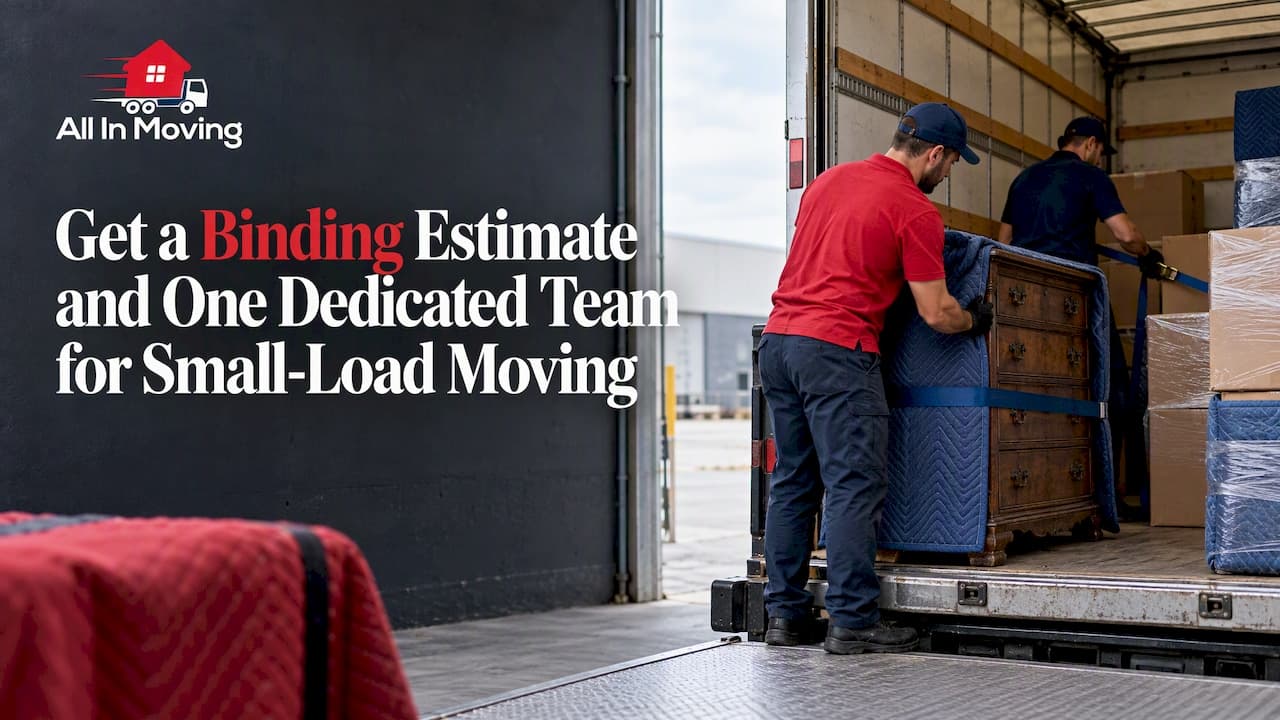
If the trade-offs above point you toward schedule certainty and full-service handling, All In Moving is worth a direct look. The company doesn't broker your move out to subcontractors: one dedicated team manages packing, logistics, and delivery from the first estimate to the final box, which removes the handoff risk that causes most of the confusion in long-distance moves.

All In Moving provides binding estimates so the number you agree to is the number you pay, with no hidden fees added at delivery. Services include:
- Residential Moving for households relocating long-distance, with professional packing and a dedicated crew.
- Commercial Moving for offices and businesses that need coordinated logistics on a set timeline.
- International Moving with customs clearance support for households relocating abroad.
This setup fits readers who value a fixed delivery date, want one point of contact throughout the move, and would rather pay for certainty than manage a consolidated shipment's wider window themselves. If that describes your situation, you can request a binding estimate for your residential or commercial move or get details on international moving and customs support directly from the team handling the job.
FAQ
What is the cheapest option for moving a small load?
Consolidated or freight-based moving is typically the lowest-cost option for a small load, since you share truck space with other shipments instead of paying for a dedicated vehicle. The trade-off is a wider delivery window, as FreightWaves reporting on small-load movers explains, so it works best when you don't have a fixed deadline.
Is $100 each a good tip for movers?
Tipping amounts vary widely by region, crew size, and job difficulty, and there's no official standard movers or regulators publish. Many people base the tip on a percentage of the total move cost or a flat amount per mover reflecting the hours worked and the difficulty of the job, so treat any specific figure as a personal choice rather than a fixed rule.
How can I move with very little money?
Labor-only service paired with a rental truck is typically the lowest-cost structure, since you avoid paying for a dedicated long-distance vehicle. Packing your own boxes, choosing Released Value coverage on low-value items, and accepting a consolidated delivery window instead of a guaranteed date also reduce cost.
What's the cheapest day to hire movers?
Demand for movers tends to run lower on weekdays and in the middle of the month, since most leases and closings cluster around weekends and month-end. Asking for flexible pickup and delivery dates, rather than insisting on a specific day, also tends to lower the price on consolidated or freight-based services.
How does weighing and reweighing work on a small load move?
Movers typically weigh the truck empty before loading and again after your goods are loaded to determine the shipment's billable weight. FMCSA's rules on pickup procedures give customers the right to request a reweigh at delivery if the billed weight appears inaccurate.