
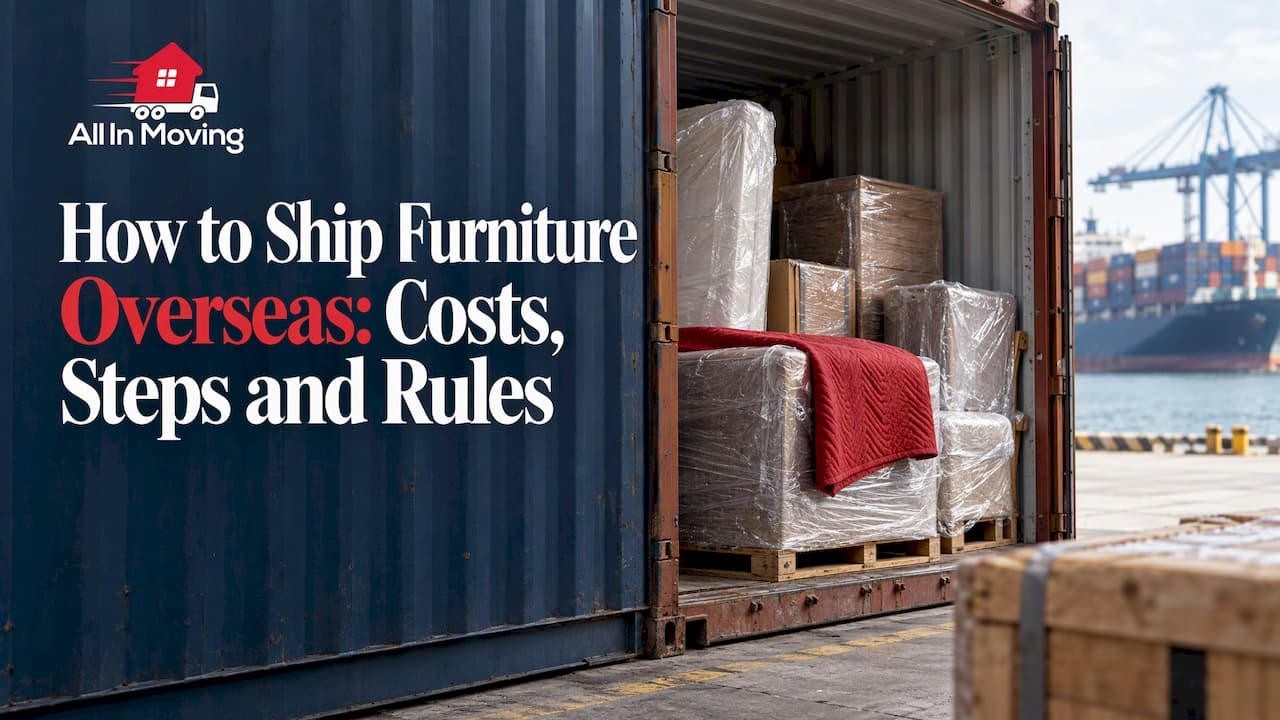
You can ship furniture overseas, and for a full household it usually travels by sea, either in a container of its own or in a shared one. What decides whether it makes sense is the volume you send, how the pieces are packed, and the customs rules at the other end. Prices swing widely with all three. This guide walks through the options, the real cost drivers, a step-by-step process, the paperwork, and a way to decide what is worth shipping and what you should sell.
TL;DR
- Sea freight is the standard choice for furniture and household goods. Air freight is for small, urgent items only.
- Cost depends mostly on volume, distance, packing, and the destination's port and customs charges. Get a written, binding estimate based on a full inventory, not a rough number over the phone.
- Customs rules differ by country. Many allow duty relief for used goods if you are relocating, but only with proof of ownership, use and residence.
- Wood crates and pallets must be heat-treated and stamped to international standards, or the shipment can be refused.
- Ship what is expensive to replace or has real value to you. Sell bulky, cheap or old pieces and buy again.
Table of Contents
- Your shipping options, compared
- What it costs to ship furniture overseas
- How long it takes
- How to ship furniture overseas, step by step
- Packing furniture for an ocean voyage
- Customs, duties and what you cannot ship
- Is it worth shipping your furniture?
- Our perspective
- How All In Moving can help
- Common mistakes to avoid
- FAQ
- Sources
Your shipping options, compared
There are really three ways to get a sofa, a dining table or a bedroom set across an ocean.
| Method | Best for | Trade-offs |
|---|---|---|
| Full container (20 ft or 40 ft) | Whole-home moves, large furniture | You pay for the container whether or not it is full |
| Shared (consolidated) container | Several rooms or a few big pieces | Cheaper per piece, but your goods wait for the container to fill and clear customs with others |
| Air freight | Small, urgent or fragile items | By far the most expensive per pound |
Sea freight is generally the most cost-effective route for large volumes of household goods, as Wise's overview of moving belongings overseas also notes. Air makes sense for a few boxes you need in the first week, such as work equipment, documents and kids' essentials, while the furniture follows by ship.
A few pieces of furniture, say a sofa and a desk, are the awkward middle. A full container is more than you need, and a shared container can work well. Parcel carriers rarely accept oversized furniture internationally, and when they do, dimensional pricing makes it costly.
What it costs to ship furniture overseas
Anyone who gives you a single price for "shipping furniture overseas" without asking about volume, origin and destination is guessing. The same sofa can cost very different amounts depending on these factors:
- Volume and weight. Sea freight is priced by space (cubic feet or meters) or by container. Bulky furniture takes up space without weighing much, so it is expensive for what it is.
- Route. Distance matters, but port congestion, how often ships sail, and whether your destination has a major port matter just as much.
- Packing. Professional wrapping, blanketing, disassembly and crating add labor and materials. They also reduce the risk of damage claims.
- Origin and destination services. Pickup from your home, delivery to your new door, stairs, long carries, elevator reservations and storage if you are not ready to receive the goods.
- Destination charges. Port handling, customs brokerage, inspections, duties and taxes. These are the items that most often surprise people.
- Insurance. Carrier liability on ocean freight is minimal, so separate cover is worth pricing. We cover this in our guide to international moving insurance.
For a realistic range, our own breakdown of international moving costs and a four-step budget puts full international moves anywhere from about $3,000 to $30,000, depending on household size and route. Furniture-only shipments sit at the lower end of that range, but only if you are selective about what goes.
Why quotes differ so much
Two quotes for the same move can be thousands of dollars apart. Common reasons: one is based on a rough estimate of volume and the other on a full inventory; one includes destination delivery and the other stops at the port; one includes packing and the other assumes you will do it. Always compare quotes line by line, and ask what happens to the price if the actual load is bigger than estimated. A binding estimate removes that risk because the price is fixed against a defined inventory.
How long it takes
The ocean leg is only part of the timeline. Door-to-door, you should plan for pickup and packing, waiting for a container to fill if you share one, port loading, the voyage, then customs clearance and delivery. For a transatlantic or transpacific move, many households should plan for roughly one to three months door to door, and longer for remote destinations or during peak season. Short routes can be much faster: sea transit between Miami and Costa Rica, for example, is reported at about 7 to 14 days, though handling and customs make the real total considerably longer.

Build a buffer. If your lease ends or your job starts on a fixed date, plan for temporary furniture or a short rental so a delayed container does not become a crisis.
How to ship furniture overseas, step by step
- Decide what is going. Walk through each room and sort items into ship, sell, donate and discard. Do this before requesting quotes, because every cubic foot you remove lowers the price.
- Build an inventory. List every piece with dimensions, approximate value and condition. You will need this for quotes, insurance and customs.
- Check the destination's import rules. Look at the customs authority's own website for duty relief for used household goods, the required documents, and any prohibited or restricted items.
- Get binding quotes. Ask for in-home or video surveys, not phone estimates. Confirm what is included: packing, loading, ocean freight, destination clearance, delivery, unpacking.
- Prepare the furniture. Clean it, empty drawers, and disassemble beds, tables and shelving where possible. Photograph every piece before packing.
- Pack properly. See the next section.
- Arrange insurance. Declare real replacement values and read what is excluded.
- Complete customs paperwork. Your mover or broker usually files, but you supply the inventory, passport or residence documents and proof of ownership.
- Track and receive. Be present or send a trusted agent at delivery. Check items against your photos and note any damage on the delivery paperwork before signing.
Packing furniture for an ocean voyage
A container is lifted by cranes, stacked, rocked for weeks and opened in humid ports. Furniture that survives a domestic truck can still be damaged at sea.
- Wrap wood and upholstery in moving blankets and stretch wrap, then add corner protection. Avoid sealing wood tightly with plastic for long periods in humid conditions without ventilation or desiccant, since trapped moisture can cause mildew.
- Disassemble legs, headboards and shelves. Bag and label hardware and tape it to the piece.
- Crate anything fragile, valuable or irregular. Glass tabletops, mirrors, marble and antiques need custom crates or sturdy cartons made for the purpose.
- Fill voids in a container with straps, bracing and padding so nothing shifts.
- Use double-wall boxes for small items and drawer contents.
Wood crates and the ISPM 15 stamp
Wooden crates, pallets and braces are plant-health risks, so most countries require them to be treated and marked under the international ISPM 15 standard. The U.S. Department of Agriculture states that wood packaging entering the country must be pest-free, debarked, heat-treated or fumigated, and carry the ISPM 15 mark, and that noncompliant shipments are not allowed in. Other countries apply similar rules. Ask your mover to confirm that crates are stamped. Untreated wood can mean refusal, re-export or forced fumigation at your cost.

Customs, duties and what you cannot ship
This is where DIY shipments most often go wrong. Rules are national, so check the country you are moving to.
Duty relief is conditional. Many countries exempt used household goods for people who are moving their residence, but only if conditions are met. Croatia, for example, treats furniture and appliances as household goods, and people moving from outside the EU may qualify for duty and VAT exemption if they meet its residence, ownership, use and household-purpose conditions. The UK offers Transfer of Residence relief; a successful claim means no import duties on household goods and personal possessions brought in. The pattern is the same everywhere: relief depends on documents, not on goodwill at the port.
Returning to the United States? U.S. Customs and Border Protection says used household goods can come in duty-free if you used them for at least one year while abroad and they are not intended for sale. Keep purchase and ownership records.
Describe the contents precisely. CBP asks for clear commodity descriptions, and vague labels such as "Household Goods" are unacceptable unless covered by a Personal Effects Accounting Document. Other customs services want the same level of detail. Costa Rica's rules, as summarized in one guide, call for a detailed inventory of each item with description, estimated value and quantity. A thorough inventory is not busywork: it is what clears your goods.
Restricted and prohibited items. Food, plants, soil, certain animal products, weapons, flammables and some medicines are commonly restricted. Northern Ireland, for instance, bans meat and dairy imports from non-EU countries and restricts some plants. Furniture itself is rarely banned, but items made from protected woods, ivory or other wildlife materials, and antiques, can need permits. Pantry goods, houseplants and cleaning chemicals should usually stay behind; if you are thinking of bringing plants, see our notes on moving with plants.
Because rules change, confirm the current requirements with the destination's customs authority or consulate before you book.
Is it worth shipping your furniture?
Here is a simple test for each piece.
- Estimate the shipping share. Take the total quote and divide it by your cubic footage. A large sofa might take as much space as 40 boxes of books.
- Compare with replacement. Price a comparable item at your destination, including delivery. In some countries, furniture is cheaper or better made locally; in others, it is costly.
- Weigh sentiment and quality. Solid wood, custom or inherited pieces are worth shipping. Particleboard flat-pack usually is not.
- Consider fit. Check ceiling heights, door widths, stairs and elevators, and electrical standards for lamps and appliances. A 110V appliance may not work on 230V.
- Count resale value. Sale proceeds plus avoided shipping cost is the real price of keeping an item.
A rule many movers share: if an item would cost less than roughly a third of its shipping share to replace, sell it. Treat that as a rough guide, not a law, and run the numbers on your biggest pieces first. Beds, mattresses and large sectionals are the usual candidates for selling; dining tables, desks, bookcases and art are the usual keepers.
Our perspective
Most people we talk to are not confused about what a container is. They are worried about who touches their furniture and what the final bill will be. In our experience, the second worry comes from how the industry is organized: many companies that sell you an overseas move act as brokers, then hand your goods to a chain of subcontractors at different stages. When something is chipped or delayed, nobody owns it.
We do it differently. One dedicated team manages the move from pickup to delivery, with no brokers and no handoffs, and we give binding estimates so the number you agree to reflects the actual cost. For furniture, that means the people who surveyed your home are accountable for how it is packed and delivered. Our advice: be honest at the survey about every piece, including the garage and the attic, because a complete inventory is what keeps a price from changing later. And ship less than you think. The cheapest cubic foot is the one you do not send.
— Sami
How All In Moving can help
If you are moving abroad with more than a couple of pieces, we handle the whole job: professional packing, logistics coordination, customs clearance support and delivery to your new door, all by a single team. See how it works on our international moving page, or learn how door-to-door delivery is handled once your goods arrive in the destination country.

We also move homes and offices over long distances within the U.S., which helps if your goods must travel to a departure port first. Tell us what you are planning through All In Moving and we will build a binding estimate from your inventory.
Common mistakes to avoid
- Shipping without an inventory. Customs may hold goods they cannot identify.
- Choosing the lowest quote without reading it. A cheap price that excludes destination handling or delivery is not cheap.
- Skipping insurance. Basic carrier liability is limited, so check what you would actually recover for a damaged dining set.
- Ignoring storage gaps. If your new home is not ready, storage fees can add up; our article on storage in transit explains how to avoid being surprised.
- Forgetting wood treatment. Untreated crates can derail the whole shipment.
- Sending items that will not work abroad. Check voltage, plug types and local safety standards.
FAQ
Can you ship furniture to another country?
Yes. Furniture and household goods can move internationally by sea or air, and most countries allow used personal furniture to be imported. Some offer duty relief if you are relocating, but you will need proof of residence, ownership and prior use. Check the destination customs authority before shipping.
What is the cheapest way to send furniture overseas?
Sea freight is usually the cheapest method for bulky items, and a shared container is cheaper than a full container if you have only a few pieces. Reducing volume, by selling bulky or low-value items and disassembling the rest, lowers the price further. Air freight costs far more per pound and suits only small, urgent goods.
How do I ship household goods overseas?
Sort and inventory your belongings, check the destination's import rules, get binding quotes, pack and crate with ISPM 15-compliant wood where needed, insure the goods, and complete customs paperwork. A mover that handles packing, freight and clearance as one team keeps the process simpler than coordinating several vendors.
What items cannot be shipped internationally?
Restrictions differ by country, but food, plants, soil, weapons, flammable or hazardous materials and some animal products are commonly restricted or banned. Items made from protected wildlife materials may need permits. Always check the customs authority of the destination country.
Sources
- Wise: cheapest way to move belongings overseas
- USDA APHIS: Import ISPM 15-compliant wood packaging material
- Croatia: shipping household goods into the Republic of Croatia
- GOV.UK: bringing personal items to the UK
- CBP: Know before you go, traveling abroad
- CBP: acceptable vs unacceptable cargo descriptions
- DAERA: personal food import restrictions
- CostaRicaBoard: shipping household goods to Costa Rica