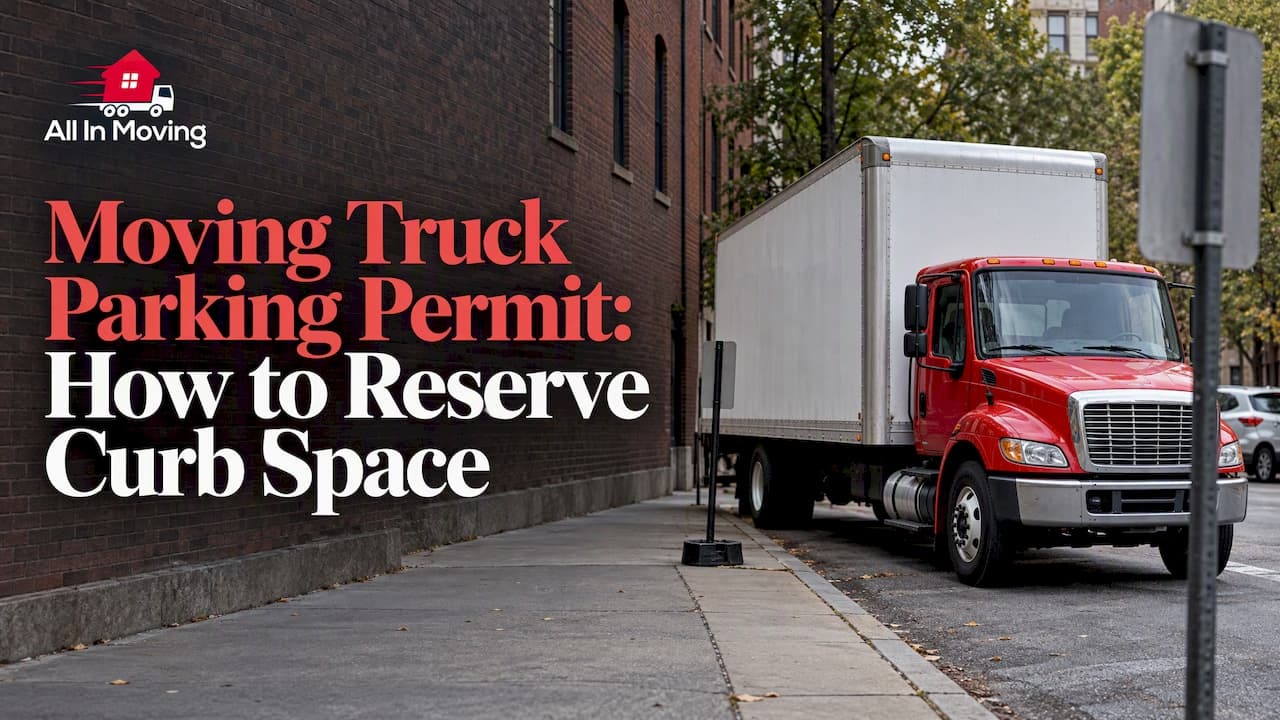
A moving truck parking permit is a short-term approval from your city that lets you reserve curb space in front of your home on moving day. Most US cities issue it through a transportation, public works or parking office, and the fee, lead time and sign rules change from one city to the next. In some places the permit is optional. In others, parking a large truck on a residential street without one can mean a ticket or a tow.
This guide covers when you need a permit, who to call, what it costs in several large cities, how early to apply, how to post the signs and what can still get a truck towed even when you hold a permit.
TL;DR
- A permit is not required everywhere. Boston calls it optional but says it guarantees a legal spot for the day. Other cities, like West Hollywood, require one for larger vehicles on residential streets.
- Apply with your city's transportation, parking or public works office. Lead times range from a few business days to several weeks.
- Fees are per space, per day. Published examples: $69 in Boston, $50 or $25 per 40 feet in Philadelphia, and $16 in Seattle.
- Signs usually have to be posted 24 to 72 hours ahead. If they go up late, the reservation may not be enforceable.
- A permit does not override snow emergencies, construction zones, accessible spaces or tow zones.
Table of Contents
- Do you actually need a permit to park a moving truck?
- Which office issues the permit, and how to apply
- What it costs: examples from US cities
- How far ahead to apply and what to have ready
- Posting the signs correctly
- Restrictions a permit does not override
- Our perspective: treat the permit as part of the move plan
- Moving abroad: containers and extra rules
- How we help on moving day
- A step-by-step plan
- FAQ
- Sources
Do you actually need a permit to park a moving truck?
It depends on the city, the street and the size of the truck.
Boston is the clearest example of an optional permit. The city says a moving-truck permit is not required, but it guarantees you a legal parking spot for the day of the move. Without it, you are competing with neighbors' cars for the curb, and a truck circling the block while your crew waits is expensive.
Other cities draw the line by vehicle size. West Hollywood requires permits for vehicles over 24 feet long or weighing more than three-quarters of a ton when they park on residential streets. A typical long-haul moving truck is well above that.
Seattle separates two things. The city allows temporary no-parking zones for moving vans, and it also has a Restricted Area Truck Permit for trucks. Reserving the curb and authorizing the truck to sit there can be two separate approvals, so read the whole page for your city rather than the first paragraph.
Montréal's rules show how many variables can matter. A permit may not be needed if your move does not prohibit parking, block a sidewalk or bike path, or take place on a metered street. It is needed in those cases, and for moving-company activity.
When a permit is a smart idea even if it is optional
Get one if any of these apply:
- Your street is lined with parked cars most evenings.
- The truck is a full-size tractor-trailer or a 26-foot box truck, which needs a long, clear stretch.
- You live in a dense neighborhood with meters, bike lanes or narrow lanes.
- Your building has no loading dock or private driveway.
- Your movers charge by the hour, so every minute spent walking furniture a block away costs money.
Which office issues the permit, and how to apply
There is no national permit. Your city, or sometimes your county or borough, issues it. Search for your city name plus "temporary no parking permit" or "moving truck permit." The office is usually one of these:
- The parking clerk or parking authority
- The transportation department
- Public works or right-of-way services
- The police or traffic division, which may handle sign pickup
Two examples show the range of processes.
Philadelphia. The Department of Streets issues Temporary No Parking permits. You apply online, and the Right-of-Way Unit reviews the application, sends an invoice and issues the final permit after payment. You then print it and take it to a police district to get the temporary signs.
Culver City, California. Applicants confirm the location is within city limits, give the truck size and owner, contractor or agent details, apply through the online reserve-space portal and allow up to five business days for review.
If you are not sure which office handles your address, call the city's main information line. Addresses near a city boundary can fall under a neighboring jurisdiction, which is why Culver City asks you to confirm location first.
What it costs: examples from US cities
Fees are set locally and change, so treat these as published examples and confirm on the city page before you budget.
| City | Published fee | Notes |
|---|---|---|
| Boston | $69 for one day, two non-metered spaces; two metered spaces cost an additional $40 | Standard permit covers two spaces, 7 a.m. to 5 p.m. |
| Philadelphia | $50 per 40 feet per day in Center City or University City; $25 per 40 feet per day elsewhere | Apply at least four business days ahead |
| Seattle | $16 per truck for up to two days, $8 per truck for each extra day | Metered-space sign installation and removal costs $18.50, plus lost meter revenue |
| Outremont (Montréal) | Free | Email the application at least 48 hours ahead |
| West Hollywood | Contact the permit office for current rates | Apply at least eight business days ahead |
The pattern: a permit is usually cheap compared with the cost of a moving crew standing idle. The metered-space surcharges matter more than the base fee, because every metered space you take out of service costs extra.
A quick cost example
Say you are moving within Philadelphia, outside Center City, and your truck needs about 40 feet of curb. At the published rate of $25 per 40 feet per day, a one-day permit for that stretch is $25. If the same move were in Center City, the published rate is $50. Philadelphia says 40 feet is roughly two parking spaces, so ask your mover how much length the truck really needs before you apply, and do not reserve less than that.
How far ahead to apply and what to have ready
Lead times vary widely, and a late application is the most common reason a permit fails.
- Boston: apply online 15 days to eight weeks before the move, or in person three days to eight weeks ahead, and list the address you are moving into.
- Philadelphia: at least four business days.
- West Hollywood: at least eight business days, plus two to three business days for payment processing.
- Culver City: up to five business days for review.
- Vancouver (Canada): at least 7 to 10 business days from payment. Requests five to seven business days ahead need an email assessment and are not guaranteed.
My rule of thumb: apply as soon as your move date is firm, and never later than the city's minimum plus a few days of margin. A move date that slips can cost you the permit, so check how your city handles date changes.
Information most applications ask for
Gather these before you start:
- The exact address where the truck will park, which is usually the address you are loading or unloading.
- The move date and the hours you need.
- Whether the spaces are metered. Vancouver asks for meter identification numbers and any existing restrictions on the block.
- The truck length, and who owns or operates it.
- Your contact details and, if a mover applies for you, theirs.
Boston also requires that the requested spot be a legal parking space. Seattle is similar: any valid paid or unpaid on-street space may be considered, but already restricted zones generally cannot be reserved. Vancouver's permits cannot be used to take over a space lawfully occupied by a parked vehicle, which is a good reminder that the permit reserves empty curb, not curb with a neighbor's car on it.
Posting the signs correctly
The permit alone does not clear the curb. In most cities, signs do the work, and the timing is strict.
- Boston: post signs and flyers at least 48 hours before the move. Physical permits usually arrive by mail within 7 to 10 business days, so a late application can leave you without paper in hand.
- Seattle: for an unpaid space, place barricades 72 hours ahead and attach public notice to at least two signs per block, with legible dates and times. State enforcement requires at least 24 hours' notice.
- Philadelphia: take the printed permit to a police district for temporary signs and post them at least 24 hours before the reservation.
- West Hollywood: residential signs must be posted 72 hours ahead and commercial signs 24 hours ahead.
- Montréal: only authorized, rented temporary signs may be used. Install them 12 to 14 hours before occupancy, then notify the Agence de mobilité durable online.
- Santa Monica: curb space for a moving truck can be reserved for a maximum of 72 hours.
Post signs where drivers will see them: at both ends of the reserved stretch and, on a longer block, in the middle. Write the date and hours legibly and photograph each sign with a timestamp. If a car stays and you need to ask for a tow, that photo shows you posted on time.
A warning on the order of steps. In Philadelphia, enforcement depends on a completed chain: review, payment, final permit, police-issued signs and timely posting. Submitting an application is only the start. If any link is missing, you may have no enforceable reservation.

Restrictions a permit does not override
Holding a permit does not make every curb available. Boston, for example, tells applicants to check snow-emergency, construction-zone, accessible-parking and no-stopping, standing or tow-zone restrictions, because a moving permit does not override them.
Before moving day, walk the block and look for:
- Street-cleaning or snow-route signs that apply on your date
- Fire hydrants, bus stops and driveway cuts
- Accessible parking spaces and loading zones
- Construction fencing or permits already posted
- Low branches, wires or tight turns your truck cannot clear
If a car is in the signed zone during the permit period, enforcement is usually a phone call away. In Philadelphia, the local police district can issue a ticket, and the vehicle may then be towed. Save the number of the relevant district or parking enforcement office in your phone before the day starts.
Our perspective: treat the permit as part of the move plan
People tend to think of the curb as a detail they will sort out when the truck arrives. We see it differently. The curb is where a long-distance move either starts smoothly or starts with a crew carrying furniture a block and a half. Because every part of your move is handled by one dedicated team, with no brokers and no handoffs, we can plan truck size, crew timing and access in one conversation instead of passing it down a chain of subcontractors. That matters here: the truck length decides how much curb you need, and the permit decides whether you have it.
Our advice is simple. Tell your mover the truck length before you apply, ask whether they have worked your street before, and agree on who files the permit and who posts the signs. Do not assume it is covered. And ask for a binding estimate that reflects the plan you actually have, including a longer carry if the curb falls through, so there are no surprises on the day.
— Sami
Moving abroad: containers and extra rules
International moves bring containers and larger vehicles, and cities treat those separately. Montréal's rules vary by borough, and a permit may be required for metered streets, blocked sidewalks or bike paths, commercial movers, or shipping containers for moves abroad. Even within one city, the deciding factors can be meters, blocked public space, bike paths and whether the move is commercial.
If you are shipping overseas, ask early whether a container will sit on the street the day before loading. That can mean a longer permit window than a single day. Your mover should also be able to tell you how customs paperwork and pickup timing fit around it.
Vehicle size, weight, use and duration can each change the permit type. West Hollywood, for example, has separate residential, commercial, overnight and oversized categories. When you read your city's page, find the category that matches your truck rather than the one that sounds closest.
How we help on moving day
If you are planning a long-distance or international move, we handle the whole job with one team: packing, logistics, delivery and, for overseas moves, customs clearance. Our estimates are binding. You can see how a residential or commercial move works, or read about international moving if you are crossing a border. Tell us about your street when you ask for a quote, and we will plan the truck and crew around it.
A step-by-step plan
- Confirm the move date and the address where the truck will park.
- Ask your mover for the truck length and how long loading is expected to take.
- Find your city's permit page and check whether a permit is required, optional or restricted for your vehicle.
- Apply early, following the city's minimum lead time plus a buffer.
- Pay and wait for the final permit, and do not assume approval until you have it.
- Collect or print signs from the issuing office, if that is how your city works.
- Post signs at the required hours ahead, and photograph them.
- Check the block the day before for new restrictions, and confirm the crew's arrival time.
For what happens once the truck is in place, our moving day checklist walks through the day hour by hour. If you want to understand how your goods get from truck to doorstep, see how door-to-door delivery works. And if a tight street makes the carry long, read about loading and unloading services so you know what that labor involves.
FAQ
Can I reserve street parking for a move without a permit?
In most cities, putting out cones or chairs without a permit does not create a legal reservation. Some cities, like Boston, do not require a permit but say one guarantees you a legal spot. Without it, you have no basis to ask for a car to be moved.
Who applies for the permit, me or the movers?
Either can, depending on the city. Culver City, for example, asks for owner, contractor or agent information, so a mover can apply on your behalf. Agree on this in writing with your mover well before the date, because the permit must exist before signs can go up.
How much curb space do I need for a moving truck?
Philadelphia says 40 feet is roughly two parking spaces, and Boston's standard permit covers two spaces. A larger truck or a trailer may need more. Ask your mover for the exact length and reserve a little extra if the city allows it.
What if the permit does not arrive in time?
Call the issuing office right away and ask what they can do. Boston says physical permits usually arrive by mail within 7 to 10 business days, so apply early enough to leave room for that. If the paper does not arrive, ask whether the office can reissue it or confirm approval in writing.
Does a permit stop my truck from being towed?
Not always. The permit reserves ordinary curb space but does not suspend higher-priority controls such as snow emergencies, construction zones or tow zones. Check the block for those restrictions before you rely on the reservation.
Sources
- Reserve A Parking Spot For Your Moving Truck | Boston.gov
- Moving Truck Permit FAQs | Boston.gov
- Apply for a Temporary No Parking (TNP) permit | City of Philadelphia
- Temporary No Parking Zone Reservation | Seattle Department of Transportation
- Parking Moving Permits | City of West Hollywood
- Application for a Dumpster, POD or a Moving Truck Permit | Culver City
- How to Get a Temporary No Parking Sign | City of Santa Monica
- Park a moving van or moving truck | Ville de Montréal
- Reserve parking spaces and parking meters with temporary permits | City of Vancouver